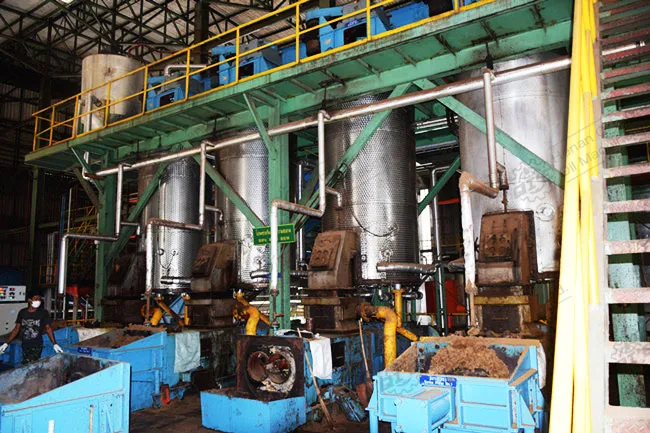
Evaluating the Technical Advancement of a Rice Bran Oil Production Line: What to Verify
Using Qi'e Grain and Oil Machinery’s Rice Bran Oil Production Line as the reference, this page provides a verification-oriented evaluation framework for technical leaders—covering rice bran feedstock suitability and stabilization, coordinated pre-treatment/pressing/extraction/refining/winterization, key quality-stability control points, automation and unit energy consumption metrics, and EHS boundaries for solvent extraction, wastewater recovery, and off-gas treatment.
Technical teams evaluating a Rice Bran Oil Production Line often face the same challenge: different suppliers describe “advanced technology,” yet what matters for project approval is what you can verify—feedstock suitability, process synergy from extraction to refining, quality stability evidence, energy/automation indicators, and clear EHS boundaries.
This page uses Qi'e Grain and Oil Machinery Co., Ltd. (Penguin Group) as the reference system and provides a verification-oriented checklist for B2B edible oil processing projects—especially where export-oriented compliance and stable, repeatable operation are required.
Reference System
- Line: Rice Bran Oil Production Line
- Scope: pre-treatment → (optional) pre-pressing → solvent extraction → refining → winterization → packaging
- Design intent: high automation, energy-efficient operation, environmental protection
- Standards focus: food safety, solvent extraction safety, off-gas & wastewater handling
1) Feedstock Fit: What to Verify Before You Review the Process
The technical advancement of rice bran oil processing starts with feedstock reality. An evaluation should explicitly verify the supplier’s approach to rice bran freshness, moisture control, storage conditions, and whether a stabilization strategy is considered where needed. These items influence extraction efficiency and downstream quality stability more than a single equipment specification.
Practical verification points
- How the line handles freshness and storage time sensitivity typical of rice bran.
- Moisture and impurity management in pre-treatment (cleaning, conditioning, size control).
- Clear distinction between rice bran and rice husk in feedstock assumptions and equipment configuration.
Evidence you can request
- Process flow diagram (PFD) and control philosophy that shows where feedstock variability is compensated.
- Operating boundary notes: allowable moisture/impurity ranges and related alarms/interlocks.
- Commissioning plan describing how feedstock trials are validated during start-up.
2) Process Synergy: Pre-treatment, Extraction, Refining & Winterization as One System
An “advanced” rice bran oil production line is not a set of isolated machines. It is a coordinated process chain that matches product targets (grade, stability, clarity) with the right configuration of pre-treatment, (optional) pre-pressing, solvent extraction, refining, and winterization.
| Stage |
What “synergy” means in evaluation |
Verification focus |
| Pre-treatment |
Creates stable, controllable input for extraction and refining. |
Feed handling logic, conditioning, instrumentation, and maintainability. |
| Pre-pressing (optional) |
Used when project targets require a configured balance between pressing and leaching. |
Decision criteria: capacity goals, oil recovery approach, and operational complexity. |
| Solvent extraction |
Mass transfer, solvent management, and safe operation integrated with EHS systems. |
Interlocks, solvent handling boundaries, recovery concept, and off-gas control. |
| Refining |
Stabilizes edible oil quality and supports storage stability for market distribution. |
Critical control points, cleaning/food safety design, and repeatability. |
| Winterization & grading |
Configured based on product clarity and low-temperature stability requirements. |
Cooling/filtration concept, controllability, and spec alignment. |
Qi'e Grain and Oil Machinery’s reference line is designed to support one-stop integration from raw material processing to finished oil, with configurable modules that can include pre-pressing, leaching, refining, winterization, and grading—so the process can be aligned to the customer’s output and quality targets without forcing a one-size-fits-all layout.
3) Quality Stability: Control Points and Proof, Not Claims
For technical leaders, “quality” is meaningful only when the supplier can show where quality is controlled and how stability is maintained over time. In rice bran oil processing, verification should focus on the consistency of key processing conditions and the robustness of the line against feedstock variability.
What to check in the design
- Critical control points identified across extraction → refining → winterization, with measurable parameters.
- Food-safety-oriented construction of equipment and pipelines, consistent with edible oil production expectations.
- Ease of operation and management enabled by automation rather than manual intervention.
What to ask the supplier to provide
- A commissioning and acceptance approach describing how stable operation is demonstrated.
- Control architecture summary: PLC/SCADA scope, alarms, trend logs for key units.
- Maintenance concept and wear-part accessibility (supports long-term quality stability).
Note: rice bran oil is often valued for its vitamin E and antioxidant content; an evaluation should confirm that the process configuration and control strategy aim at producing high-quality edible oil without introducing unnecessary instability through poor coordination between units.
4) Automation & Unit Energy Consumption: Evaluate Operability and Long-Term Cost
A rice bran oil production line built for global B2B projects should show a practical balance: high automation to reduce operator dependence, and energy-efficient operation to support predictable long-term costs. Qi'e’s reference line emphasizes low energy consumption, low emissions, and simplified maintenance as part of total lifecycle operation.
Automation verification checklist
- Degree of automation across raw material handling, extraction, refining, and packaging.
- Start/stop logic, abnormal condition handling, and operator guidance.
- Data visibility for stable production management (trends, alarms, batch/shift records).
Energy-efficiency questions to ask
- How the process is optimized to reduce energy losses across heating/cooling/evaporation needs.
- Whether unit energy consumption is tracked by design (metering points and KPIs).
- How maintenance strategy supports sustained efficiency (not only initial performance).
Evaluation tip: Ask for the operating boundary conditions under which efficiency claims are valid (feedstock assumptions, operating hours, ambient conditions). This makes energy/throughput discussions auditable during project review.
5) EHS Boundaries for Solvent Extraction Projects: Safety, Off-gas & Wastewater
If the configuration includes solvent extraction, EHS is not an add-on. A technically advanced line should define clear operational safety boundaries, supported by engineering controls. Qi'e’s reference system highlights environmental protection measures and is designed to align with modern expectations for emissions and recovery.
EHS verification areas
- Solvent extraction operational safety: interlocks, monitoring, and procedural requirements aligned with the process design.
- Off-gas treatment: how exhaust streams are managed and controlled.
- Wastewater recovery: whether recovery/handling is integrated into the line concept.
- Food safety considerations: material selection and hygienic design approach for edible oil production.
Documentation typically used in project review
- EHS boundary description for solvent areas and utilities interfaces.
- Layout concept addressing safe access, maintenance isolation, and controlled zones.
- Environmental handling concept covering wastewater recovery and off-gas treatment integration.
Why Use Qi'e (Penguin Group) as a Reference Supplier
Qi'e Grain and Oil Machinery Co., Ltd. (Penguin Group) focuses on R&D, manufacturing, sales, and service for grain and oil machinery, including oil pressing equipment, oil production line equipment, and edible oil refining equipment. The company supports B2B projects with a solution-oriented approach—design, installation guidance, and technical service—so technical requirements can be traced from process objectives to equipment configuration.
Engineering focus
- High automation for easier operation and management
- Energy saving and efficiency-oriented process configuration
- Environmental protection integration (off-gas & wastewater concepts)
Project fit
- Export-oriented B2B edible oil processing projects
- Customers needing configurable quality & output targets
- Teams requiring verifiable review materials
Use This Page as an Internal Review Checklist
For a rice bran oil production line project, align your evaluation around what can be confirmed: feedstock fit and stabilization logic, coordinated extraction/refining/winterization design, critical quality control points, automation and unit energy consumption observability, and explicit EHS boundaries for solvent extraction, wastewater recovery, and off-gas treatment.
If you need a technical review package
You can request a process configuration discussion based on your target product positioning and capacity expectations, including the line module selection (pre-treatment, extraction, refining, winterization), plus EHS interface considerations for solvent areas.